Learn how to find a reputable, ANKC-registered Pomeranian breeder in Australia. Understand the difference between Limited and Main Registration, what ethical breeders provide, red flags to avoid, and how to choose a healthy, well-bred Pomeranian puppy.
Are you looking for a quality Pomeranian puppy from a breeder you can trust? On this page, you’ll learn what “registered breeder” really means, how to choose a breeder who puts health and temperament first, and where to find a list of Australia’s preservation-oriented Pomeranian breeders. With so many options, taking time to research will help you find a puppy that brings you years of joy.
Finding a Registered Pomeranian Breeder in Australia
Choosing the right Pomeranian breeder is one of the most important decisions you’ll make when bringing a new puppy into your life. With so many breeders advertising online—some genuine, others not—it’s essential to understand what a registered breeder actually is, why registration matters, and how to tell the difference between a preservation breeder and someone simply producing puppies for profit.
A registered Pomeranian breeder has taken the steps to be officially recognised by their state’s canine controlling body under the Australian National Kennel Council (ANKC). These breeders must adhere to rules regarding identification, record-keeping, animal welfare, and the accurate registration of litters.
However, registration alone does not guarantee quality. There is a wide range within the registered breeder community—from dedicated preservation breeders who focus on health, temperament, and maintaining correct Pomeranian type… to minimal-standard breeders who do the bare minimum to remain registered.
This guide will help you understand what “registered breeder” truly means, what to look for, what to avoid, and how to choose someone who truly cares about the welfare and future of the Pomeranian breed.
What Does “Registered Breeder” Mean?
Not only do reputable breeders ensure they breed healthy Pomeranian puppies with sound genetics, but selecting one who follows ethical breeding practices and adheres to a thoughtful breeding program when caring for their dogs is essential.
When breeders refer to being “registered,” the correct and most trustworthy meaning is registered with the Australian National Kennel Council (ANKC) through their state body, such as:
- Dogs Victoria
- Dogs NSW
- Dogs Queensland
- Dogs SA
- Dogs West
- Dogs NT
- Dogs Tasmania
An ANKC-registered Pomeranian breeder:
- Holds a legally issued, unique kennel prefix
- Registers every litter with its state body
- Provides official ANKC pedigree papers (Main Register or Limited Register)
- Breeds to the official ANKC Pomeranian Breed Standard
- Must comply with strict codes of ethics
- Keeps detailed breeding and health records
- Is accountable to their state body if complaints are made
These breeders are often involved in showing, performance sports, preservation breeding, and long-term breed improvement.
If you want a healthy, well-bred, true-to-type Pomeranian, ANKC registration is the registration that matters.
Government “Breeder Numbers” (Often Misleading)
Some breeders advertise that they are “registered” because they hold a government breeder identification number, such as:
- PER Source Number (Victoria)
- Breeder ID / BRN (Queensland)
- DACO (South Australia)
- Breeder Supply Number (NSW, WA, NT, Tasmania)
These numbers do not mean the breeder is ANKC-registered.
They allow a person to sell puppies in that state legally.
A government breeder number:
- Does not guarantee health testing
- Does not guarantee ethical practices
- Does not ensure the breeder follows the Pomeranian standard
- Does not ensure pedigree ancestry
- Does not ensure quality, temperament, or soundness
Many backyard breeders and puppy farms use government numbers to appear legitimate. This creates confusion for new buyers.
Always ask: “Are you ANKC registered with Dogs Victoria / Dogs NSW / Dogs Queensland, etc?”
If the answer is no, the breeder is not a true registered breeder in the pedigree-breeding sense.
Why This Distinction Matters
The organisation a breeder is registered with directly impacts the:
- quality and health of your puppy
- temperament and behaviour
- genetic background
- predictability of size, coat, and type
- long-term support from the breeder
- ethical standards they must follow
Only ANKC registration ensures the breeder is accountable and preserving the breed, not simply producing puppies.
How to Identify a Reputable Registered Pomeranian Breeder
Even within the ANKC-registered community, the quality of breeders varies widely. Some breeders are deeply committed to preserving correct Pomeranian type, health, and temperament… while others meet only the minimum requirements.
Use the checklist below to ensure you choose a truly reputable breeder who prioritizes the dogs—not profit—above all else.
They Are Open About Their ANKC Registration
A reputable breeder will proudly provide:
- their prefix
- their membership number
- the state body they’re registered with
They will also allow you to verify their details through the official Dogs Australia directory.
Warning sign:
If a breeder refuses to provide their ANKC prefix, or they only offer a government “breeder number,” proceed with caution.
They Produce Pedigree-Registered Litters
Every puppy from a reputable breeder receives:
- ANKC pedigree papers
- Main Register (for show/breeding homes)
- Limited Register (pet homes)
- Microchip number
- Full transparency about ancestry
These papers prove the puppy is a purebred Pomeranian with documented lineage—not a crossbred or poorly bred dog mislabeled as a Pom. They are essentially the puppy’s birth certificate, recording its parents, ancestry, breeder details, and official registration within the ANKC system.
Their Dogs Are True-to-Type Pomeranians
A high-quality breeder produces Pomeranians that:
- Have the correct size (3–7 lbs)
- Have true Pomeranian Spitz features
- Have the characteristic expression, coat, ears, and structure
- Looks like Pomeranians at maturity—not oversized “throwbacks” or unknown mixes
- They often prove their Pomeranians in the conformation ring, where dogs are judged against the official breed standard for structure, soundness, movement, coat, and temperament. This helps ensure their breeding dogs truly represent the correct Pomeranian type. In many reputable breeding programs, one or both parents will hold conformation champion titles.
Their Dogs Are Healthy and Properly Screened
Responsible breeders prioritise health testing, such as:
- Patella evaluation
- Heart check
- Eye evaluations
- Coat and skin assessment
- Dentition checks
- Breeding only healthy, sound parents
They can provide veterinary documentation when requested.
Red flag:
Breeders who claim “my dogs are healthy, so I don’t need testing.”
They Raise Puppies in a Clean, Loving Environment
Reputable breeders:
- raise puppies inside the home
- expose them to people, sounds, toys, and other safe dogs
- maintain a clean and well-structured environment
- provide proper socialisation and early training
This results in confident, stable puppies.
Warning:
Avoid breeders who:
- Keep puppies in sheds or outdoor kennels
- refuse to show you where puppies are raised
- will only meet in a neutral location (e.g., a car park)
They Ask You Questions—Lots of Them
Good breeders care where their puppies go. They will ask about:
- your home environment
- Your experience with Pomeranians
- your work schedule
- safety plans
- children, pets, fencing, etc.
A breeder who asks no questions is not concerned about the puppy’s welfare—only the sale.
They Offer Lifetime Support
Reputable Pomeranian breeders:
- happily answer questions
- help with grooming, feeding, and health advice
- remain available throughout the dog’s life
- will take the puppy back if circumstances change
This ongoing support is a hallmark of an ethical breeder.
They Are Honest About the Breed
A trustworthy breeder will openly discuss:
- grooming needs
- training needs
- fragility of the toy size
- barking tendencies
- potential health issues
They want you to make an informed, realistic decision—not a rushed one.
They Do Not Pressure You or Rush the Sale
Ethical breeders:
- Don’t push for deposits before you’ve met a puppy
- Don’t encourage impulse buying
- Don’t use high-pressure sales tactics
- allow you to ask questions without feeling uncomfortable
Signs of an Unethical or Backyard Breeder to Avoid
Unfortunately, many people advertising Pomeranian puppies—especially online—are not ethical breeders. Some are backyard breeders with limited knowledge of the breed, while others are puppy farms that produce litters solely for profit. Recognising the warning signs will help you avoid heartbreak, health problems, and financial loss.
1. They Are Not ANKC Registered
If a breeder cannot provide:
- an ANKC prefix,
- their Dogs Australia membership number,
- or verifiable pedigree registration—
Then they are not a genuine registered Pomeranian breeder.
Backyard breeders often try to sound legitimate by using phrases like:
- “registered with my council”
- “I have a breeder ID number.”
- “registered with RPBA/AA/other groups”
- “purebred without papers”
These are not indicators of true pedigree breeding.
2. They Will Not Provide Pedigree Papers
Backyard breeders avoid ANKC paperwork because:
- The parents are not purebred
- The dogs do not meet the breed standard
- They have no verifiable ancestry
- They do not want accountability
Without official ANKC papers, you cannot be sure you are getting a true Pomeranian—or even a healthy, ethically bred puppy.
3. Their Pomeranians Do Not Look Like True Pomeranians
A major red flag is when breeders produce dogs that:
- are oversized “throwbacks”
- look like long-haired Chihuahuas
- have incorrect heads, ears, or coats
- lack the thick double coat or breed expression
This happens because backyard breeders do not breed to standard and often mix in other breeds to achieve certain colours.
4. They Focus on “Rare Colours”
Unethical breeders often advertise:
- merle
- blue
- lavender
- “exotic” colours
- designer patterns
These colours usually result from crossbreeding or irresponsible breeding practices.
Many have serious Pomeranian Dog Health Problems , especially merle-to-merle matings.
Preservation breeders prioritise type, temperament, health, not gimmick colours.
5. They Offer Puppies at Very Young Ages
Reputable breeders never release puppies before:
- 8 weeks (minimum legal age)
- Often 9–12 weeks for smaller toy breeds
Backyard breeders will offer 5- or 6-week-old pups—this is illegal, unsafe, and harmful to the puppy’s development.
6. They Avoid Showing You the Puppy’s Environment
Signs of concern:
- They refuse home visits
- They only meet in a car park or a public place
- They show you puppies via video, but never the surroundings
- They use excuses such as “my house is being renovated.”
A responsible breeder has nothing to hide. While some breeders—like myself—are elderly or live alone and may understandably be cautious about inviting unknown people into their home, reputable breeders will still ensure transparency. This may include offering video calls, showing where puppies are raised, introducing the parent dogs, and providing proof of a clean, well-managed environment. Ethical breeders are open, honest, and willing to show how their puppies are cared for—just in a way that keeps everyone safe.
7. They Don’t Ask You Any Questions
Ethical breeders care about where their puppies go.
Unethical breeders prioritize profit over the well-being of their animals.
Warning signs include:
- No questions about your lifestyle
- No interest in where the puppy will live
- No discussion about potential risks (e.g., fragility, grooming)
- Willingness to sell to anyone instantly
8. They Have Puppies Available All the Time
Good breeders have occasional litters, not an endless supply.
Red flags include:
- “always available”
- Multiple litters are displayed at once
- frequent online ads
- constantly reducing or increasing prices
- offering discounts
High volume = commercial puppy farming.
9. Their Main Selling Points Are Price and Convenience
Ethical breeders emphasise:
- health
- temperament
- structure
- breed preservation
Backyard breeders emphasise:
- “cheap”
- “urgent sale”
- “first come, first served”
- “No questions, pick up today.”
- “afterpay available”
A well-bred Pomeranian is never cheap or rushed.
10. They Provide No After-Sale Support
If a breeder:
- disappears after the sale
- refuses to take the puppy back
- will not answer questions
- doesn’t provide care advice
—then they are not reputable or ethical.
Reputable breeders offer lifetime support.
Why Preservation Breeders Are Different
Not all ANKC-registered breeders operate with the same goals. Within the dog world, there is a special group known as preservation breeders—people who dedicate their lives to protecting and improving their chosen breed. These breeders play an essential role in ensuring that future generations of Pomeranians remain healthy, sound, and true to the official breed standard.
Preservation breeders do far more than produce puppies. Their work is driven by passion, knowledge, and a genuine desire to safeguard the heritage and quality of the Pomeranian breed.
1. They Prioritise Health, Temperament, and Correct Type
Preservation breeders carefully select breeding dogs only after evaluating:
- health (with documented veterinary checks)
- temperament (stable, confident, well-socialised)
- structure and conformation (correct Pomeranian type)
- coat quality
- movement and soundness
They plan matings years in advance to maintain the best qualities of the breed—not simply to produce puppies for quick sale.
2. They Breed in Very Small Numbers
Unlike commercial breeders or puppy farms, preservation breeders have:
- limited litters per year
- long gaps between litters
- carefully planned breeding programs
Every litter has a purpose—to improve the breed, not to meet market demand.
3. They Actively Show Their Dogs
Showing in the conformation ring allows breeders to have their dogs evaluated against the official Pomeranian standard.
This helps ensure they are breeding:
- correct size
- correct coat
- correct structure
- correct expression
- correct temperament
Many preservation breeders have champions behind their breeding programs, demonstrating their commitment to excellence and accountability.
4. They Are Deeply Knowledgeable About Pomeranian Lines
A preservation breeder can discuss:
- generations of ancestry
- strengths and weaknesses in different lines
- colour genetics and potential risks
- temperament traits carried in families
- health considerations
- structural faults and how to avoid them
Their decisions are grounded in decades of learning, mentorship, and hands-on experience.
5. They Offer Lifetime Support
Choosing a preservation breeder means gaining a lifelong partner.
These breeders:
- guide you through puppy raising
- help with grooming, feeding, and training
- support you during challenges
- want updates throughout the dog’s life
- will always take the dog back if needed
Their commitment does not end at the sale—it continues for the dog’s entire lifespan.
6. They Protect the Future of the Breed
Preservation breeders are the backbone of the Pomeranian’s future. Through selective breeding, they work to prevent:
- exaggerated features
- genetic health issues
- incorrect size and structure
- loss of true Pomeranian type
Their goal is not just to produce puppies today, but to ensure that the Pomeranian of tomorrow still looks, moves, and behaves like a true Pomeranian should.
7. They Are Motivated by Love of the Breed—Not Profit
Preservation breeding is expensive, time-consuming, and emotionally demanding.
Breeders who commit to this work do so because they have a deep love for the breed. Their dedication benefits every puppy they produce and every family that adopts one.
How to Verify Whether a Breeder Is Truly Registered
With so many breeders advertising online, it’s essential to verify that someone claiming to be “registered” is indeed registered with the correct organisation. Verifying this takes only a few minutes and can save you from scams, backyard breeders, and misleading advertisements.
Here’s exactly how to check whether a breeder is legitimately ANKC registered.
Examples of The Correct Pedigree Paperwork for Registered Pomeranian Puppies:
BLUE PEDIGREE – MAIN REGISTRATION
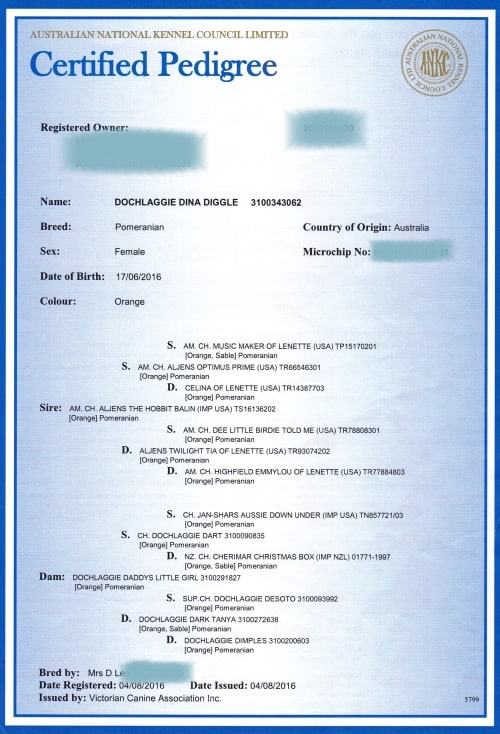
This blue one is rarely given to a pet owner because it is intended only for owners who want to breed or show the dog. Dogs required for breeding, exhibition, or export must have a main registration, which is typically represented by the blue pedigree paperwork.
The official term is MAIN REGISTRATION. There is no “MAINS” registration. Usually, only inexperienced breeders and owners refer to the main register as “mains.”
ORANGE PEDIGREE – LIMITED REGISTRATION
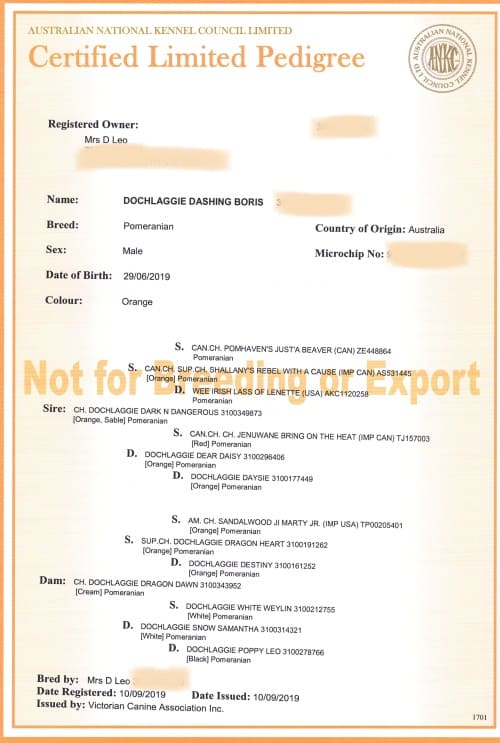
This orange pedigree is classified as “limited registration” for pet puppies. It tells people that your dog is registered as a pedigree but isn’t allowed to be bred or shown.
1. Ask for Their ANKC Prefix and Membership Number
A real registered breeder will immediately provide:
- their kennel prefix, and
- their Dogs Australia (ANKC) membership number.
If they hesitate, make excuses, or say:
- “I don’t give that out.”
- “I’m registered but not with Dogs Australia,” or
- “I have a council breeder number instead.”
Then they are not an ANKC-registered Pomeranian breeder.
2. Confirm Which State Body They Are Registered With
In Australia, ANKC breeders must be affiliated with one state body.
Ask:
“Which state are you registered with—Dogs Victoria, Dogs NSW, Dogs Queensland, etc.?”
Each state has an online membership verification tool or a way to confirm a prefix.
3. Check Their Prefix With the State Body
You can verify breeders through:
Dogs Victoria
Prefix lookup available via email or phone.
Dogs NSW
Online prefix and membership search available.
Dogs Queensland
Online database for breeders and prefixes.
Dogs SA / Dogs West / Dogs Tasmania / Dogs NT
Verification through their office or directory.
If the breeder does not appear in their state system—walk away.
4. Verify Their Litter Registration
Every legitimate breeder registers each litter with the ANKC.
Ask to see:
- A copy of a previous litter registration, or
- The “Litter Registration Certificate” for the current litter (if available).
This document shows:
- sire
- dam
- date of birth
- colour of puppies
- breeder’s prefix
- The number of puppies registered
If they cannot provide this, they may not actually be breeding ANKC puppies.
5. Check Their Website or Socials for Transparency
Reputable breeders openly display:
- their ANKC prefix
- their membership number
- show results
- photos of generations of dogs
- proof of involvement in breed clubs
- links to Dogs Australia or state body profiles
If a breeder replies with:
Backyard breeders often lack transparency, typically posting only puppy photos and pricing information.
6. Ask for the Puppy’s Full Registered Name
A proper ANKC-registered Pomeranian puppy has a formal name, e.g.:
Dochlaggie Dream Destiny
Australian Champion Tauro Kennel JP Atlantis
- “We don’t do pedigree names,”
- “Just call him whatever you want,”
- “We don’t do papers,”
—This is an immediate red flag.
7. Confirm That Puppies Come With ANKC Papers — Not Just a Government Number
A genuine pedigree puppy must come with:
- ANKC pedigree certificate (Main or Limited)
- microchip number
- breeder prefix and contact details
- full ancestry (at least three generations)
Government breeder numbers (PER/BRN/DACO) do not prove pedigree or ethical breeding.
8. Conduct a Quick Scam Check
Beware if the breeder:
- wants deposits before showing paperwork
- uses only text messages, never calls
- will not show parents
- offers “rare colours”
- has suspiciously low prices
- rushes the sale
A few minutes of checking can prevent losing hundreds or thousands to scammers.
Smart Questions That Reveal a Breeder’s True Ethics
When speaking with a breeder—whether by phone, message, or in person—certain questions help you understand far more than the basic health or registration details. These questions reveal the breeder’s experience, values, motivations, and level of care for their dogs.
These are not generic questions. These are the questions that ethical breeders appreciate and unethical breeders dislike—because they reveal the truth.
1. “What are your goals as a breeder?”
This question exposes a breeder’s purpose.
Good answers include:
- preserving the correct Pomeranian type
- improving structure, health, coat, movement, or temperament
- Reducing hereditary issues
- keeping a line going
- producing quality show prospects, or well-bred companions
Red flags:
- “We just love puppies.”
- “People keep asking for them.”
- “We breed for cute colours.”
2. “What do you look for when selecting your breeding dogs?”
This goes deeper than “are they healthy?”
Ethical breeders will mention:
- structure and movement
- temperament
- soundness
- type
- strengths and weaknesses
- long-term plan for each line
Backyard breeders often focus solely on colour or size.
3. “What traits do your lines typically produce?”
Experienced breeders know their lines intimately.
They can describe:
- temperament tendencies
- maturity rates
- coat development
- size outcomes
- strengths and areas they still want to improve
This separates seasoned breeders from people who breed random pairs.
4. “How do you decide which puppy goes to which home?”
This reveals their commitment to placement.
Quality breeders match puppies based on:
- temperament
- confidence level
- size
- family experience
- home environment
Backyard breeders respond with something like:
- “First come, first served.”
- “Pick whichever one you want.”
5. “What support do you offer if I ever have a problem?”
This question uncovers responsibility.
Ethical breeders will say they:
- are always available
- help with training, grooming, settling, and feeding
- want updates
- will take the dog back at any time
Anyone who says, “Once it’s sold, it’s yours,” is not being ethical.
6. “What is the history behind the parents’ pedigrees?”
This invites the breeder to talk about heritage. A knowledgeable breeder will explain:
- line origins
- imported bloodlines
- notable ancestors
- champions
- How those lines influenced today’s Pomeranians
Backyard breeders often have no knowledge of pedigree history.
7. “What challenges exist in your line that you actively work to improve?”
Every breeder—no matter how exceptional—has something they are working on. Ethical breeders are honest about:
- coat development
- size consistency
- tail set
- movement
- temperament traits
- dental issues
Dishonest breeders will claim everything is “perfect.”
8. “Can you tell me about the puppies you kept from previous litters?”
This exposes the breeder’s real breeding results. Ethical breeders:
- keep puppies
- grow out prospects
- evaluate them
- can discuss how those dogs turned out
Backyard breeders rarely keep anything—they only sell.
9. “What do you expect from your puppy buyers?”
This flips the dynamic. Responsible breeders often expect:
- good communication
- safe housing
- proper grooming
- responsible feeding
- staying in touch
- returning the dog if circumstances change
A breeder who expects nothing is not invested in the puppy’s future.
10. “How long is your typical waiting list?”
This indicates demand, reputation, and breeding ethics. A moderate waitlist is normal for good breeders. A breeder with puppies “always available” is a red flag.
What to Expect When Buying From a Reputable Breeder
Purchasing a Pomeranian from a reputable, preservation-focused breeder is very different from buying a puppy from online classifieds or backyard breeders. Ethical breeders follow a careful, structured process to ensure the right puppy goes to the right home. Understanding this process will help you feel confident and prepared as you begin your journey.
1. Expect to Join a Waiting List
Ethical breeders do not produce large numbers of puppies. They plan each litter thoughtfully, sometimes years in advance. This means:
- You may not get a puppy immediately
- Some colours or genders have longer wait times
- quality takes time
A waiting list is a GOOD sign—it reflects demand, reputation, and care.
2. Expect the Breeder to Ask You Questions
Reputable breeders want to ensure their puppies go to responsible, safe, loving homes.
They may ask:
- about your experience with toy breeds
- your home environment
- children and other pets
- work schedule
- fencing and safety
- lifestyle
This is not intrusive—it’s about protecting the puppy.
3. Expect to Be Matched With a Puppy Instead of “Picking One”
Preservation breeders evaluate puppies over several weeks. They assess:
- size potential
- temperament
- structure
- coat quality
- energy levels
Rather than choosing based on markings or colour, the breeder helps match you with the puppy that best suits your lifestyle.
Matching ensures SUCCESS—not impulse buying.
4. Expect to Receive Regular Updates
Once puppies are old enough, good breeders send updates such as:
- photos
- videos
- milestone reports
- growth updates
They want you to feel included in your puppy’s development before you bring them home.
5. Expect Puppies to Stay With the Breeder Until 8–12 Weeks
Toy breeds, including Pomeranians, benefit from:
- extra time with their mother
- early socialisation
- confidence building
- stability
Ethical breeders keep pups longer for their well-being.
Tiny puppies may need additional time before they are safely ready to go home.
6. Expect ANKC Pedigree Papers and Transparency
Your puppy will come with:
- ANKC pedigree papers (Main or Limited Register)
- microchip certification
- vaccination record
- deworming schedule
- health check documentation
- breeder’s prefix and membership details
These papers serve as the puppy’s birth certificate, verifying its true pedigree and lineage.
7. Expect Lifetime Support
Preservation breeders don’t disappear after the sale. They offer ongoing support because they genuinely care about their pups.
You can ask for help with:
- grooming
- training
- feeding
- behaviour
- general care
Most will gladly take a puppy back at ANY stage of life if needed. This level of support is rare outside the ethical breeding community.
8. Expect Honesty, Even When It’s Not What You Want to Hear
A reputable breeder will tell you:
- If a puppy is too tiny for a certain home
- If your lifestyle isn’t suited to the breed
- If the colour you want is unlikely
- If they don’t have any puppies available
Honesty is part of their responsibility—not a sales tactic.
9. Expect a Puppy With a Solid Foundation
By the time your puppy goes home, they should already have:
- early socialisation
- exposure to normal household sounds
- positive human interaction
- gentle grooming practice
- basic toilet habits
- confidence and curiosity
Ethical breeders prepare puppies for success long before you meet them.
10. Expect a Relationship, Not a Transaction
Buying from a preservation breeder means becoming part of a community.
These breeders love updates, photos, and staying involved in the puppy’s life. You’re not “just buying a dog”— you’re joining a breeder who is committed to the well-being of your Pom long-term.
Red Flags to Watch Out For During the Buying Process
Even if a breeder initially appears legitimate, warning signs can emerge during conversations, viewing arrangements, or payment discussions. Paying close attention to these behaviours can protect you from scams, unhealthy puppies, or unethical practices.
Here are the most important red flags to watch for while you move through the buying process.
1. Pressure to Pay a Deposit Before You’ve Verified Anything
Ethical breeders never rush or pressure buyers.
Red flags include:
- “Deposit must be paid today.”
- “I have someone else waiting—send money now.”
- “Pay the deposit before I show you the paperwork.”
Scammers and backyard breeders rely on urgency to stop you from asking questions.
2. Inconsistent or Evasive Communication
Be cautious if a breeder:
- avoids answering simple questions
- changes their story
- becomes vague when asked about registration
- refuses to provide verifiable details
- replies only late at night or sporadically
Honest breeders communicate clearly and consistently.
3. Refusal to Show You the Puppy’s Living Environment
While many breeders—particularly elderly breeders or women living alone—may reasonably restrict home visits for safety, they should still offer transparency through:
- live video calls
- recorded videos
- showing where the puppies are raised
- showing the parent dogs
- walking you through the set-up virtually
If a breeder refuses any form of transparency, it’s a warning sign.
4. Only Communicating by Text Message
Scammers often avoid phone calls or video calls. Ethical breeders are generally happy to:
- speak over the phone
- video chat
- answer questions verbally
If the breeder refuses all verbal communication, proceed with caution.
5. Offering Puppies at an Unusually Young Age
A breeder offering 5–to 6–week–old puppies is a major red flag.
This usually signals:
- poor breeding practices
- lack of concern for development
- a rush to make money
A reputable breeder will not allow a puppy to go home before 8–12 weeks, depending on size.
6. Avoiding Questions About Parents or Pedigree
Warning signs include:
- “The parents aren’t here.”
- “I can’t show you the mother.”
- “The father is a friend’s dog—no photos.”
- “We don’t really keep pedigree information.”
If they can’t prove the puppy’s pedigree, they probably don’t have one.
7. Offering “Rare Colours” as a Selling Point
Ethical breeders do not promote:
- Merle
- lavender
- blue
- Exotic marketing terms like “micro,” “teacup,” “mini,” “rare,” etc.
Backyard breeders and sellers of crossbred or genetically risky dogs often use this language.
8. No Contract or Vague Terms
A responsible breeder provides a contract that covers:
- health guarantees
- return-to-breeder requirements
- responsibilities of both breeder and buyer
- microchip and registration details
Backyard breeders often avoid contracts entirely.
9. Offering Very Cheap or “Negotiable” Prices
Pomeranians are expensive to breed ethically.
A low price usually means:
- no health testing
- no proper care
- crossbreeding
- poor-quality environment
- a breeder who wants a quick sale rather than quality
“Negotiable” puppies are often from poor conditions or rushed sales.
10. No Interest in Your Lifestyle or Suitability
If a breeder never asks:
- Who will the puppy live with
- If you have toy-breed experience
- If your home is safe for a small dog
- Your plans for training or grooming
- your schedule
…they do not care where the puppy ends up. A breeder who doesn’t care before the sale won’t care after, either.
Understanding ANKC Puppy Registration: Limited vs Main
When buying a Pomeranian from an ANKC-registered breeder, your puppy will come with either Limited Registration or Main Registration. Understanding the difference helps you choose the right option for your home and ensures unethical sellers don’t mislead you.
Limited Registration (Pet Registration)
Most pet puppies are placed on the ANKC Limited Register.
This means:
- The puppy is purebred and fully pedigree registered
- You will receive official ANKC papers
- You can participate in obedience, rally, agility, and other dog sports
- The puppy cannot be bred from
- The puppy cannot be shown in conformation shows
The Limited Register is perfect for families seeking a healthy, well-bred companion without the need for breeding or showing.
Main Registration (Show & Breeding Registration)
Puppies on the ANKC Main Register are usually kept by preservation breeders or sold to approved, experienced homes.
Main Register dogs:
- can be shown in conformation
- can be bred from (with ethical considerations)
- can have their puppies registered with the ANKC
- must represent the correct Pomeranian type and soundness
Breeders reserve Main Registration for dogs they believe have the potential to make a positive contribution to the breed.
Why This Matters
Some backyard breeders falsely claim their puppies have “papers,” when these papers are not ANKC papers at all.
Understanding Limited vs Main Registration protects you and ensures you are purchasing a genuine, pedigree Pomeranian.
Most show Australian Pomeranian breeders usually only sell pet puppies with a limited ANKC registration. Anyone breeding with a limited register Pomeranian can’t go on to register the puppies with any ANKC body if either parent has been put on a limited pedigree.
The limited pedigree exists for breeders to register dogs that they don’t think are good enough for show or breeding purposes but would make perfectly good pets. If limited-registered puppies turn out better than expected, dogs on the limited register can be upgraded to the main register. The breeder’s consent is required to move dogs between the main and limited registers.
Best Pomeranian Breeders List
In Australia, top-tier Pomeranian breeders can be found through reputable sources, such as the Pomeranian headquarters website, which lists renowned breeders nationwide. Having acquaintances with these breeders, I can vouch for their professionalism and dedication to the breed’s welfare.
If you encounter any problems or need guidance in selecting the right Pomeranian for your home, please contact me directly through my Dochlaggie Pomeranians website. My connections and experience in the Pomeranian community in Australia can be a valuable resource for potential owners, ensuring a trustworthy and supportive journey in finding your perfect Pomeranian companion.
Frequently Asked Questions (FAQ)
1. What does “registered breeder” actually mean?
A registered breeder is someone who is officially registered with Dogs Australia (ANKC) through their state body (e.g., Dogs Victoria, Dogs NSW). This is the only registration that proves a breeder produces true pedigree Pomeranians.
2. Are government breeder numbers the same as ANKC registration?
No. Council numbers (PER/BRN/DACO, etc.) only permit someone to sell puppies legally. They do not confirm the breeder is ethical or that the puppies are purebred Pomeranians.
3. What is the difference between Limited and Main Registration?
Limited Register = pet registration, purebred with ANKC papers, but not for breeding or conformation shows.
Main Register = dogs approved for showing and/or breeding. Only responsible breeders place pups on the Main Register.
4. Can a puppy be upgraded from Limited to Main?
Occasionally — but only at the breeder’s discretion. Most breeders will only upgrade if the dog matures into the correct Pomeranian type and the owner meets strict criteria.
5. At what age should Pomeranian puppies leave the breeder?
Reputable breeders typically allow puppies to go home between 8 and 12 weeks of age. Tiny puppies may need longer for safety.
6. Why don’t ethical breeders always allow home visits?
Many preservation breeders are elderly, live alone, or have concerns about their safety. Instead, they offer transparency through:
- video tours
- live video calls
- photos and updates
- viewing the mother and puppies virtually
This protects both breeder and puppies.
7. Why do some breeders have waiting lists?
Because ethical breeders produce very few litters, they often plan them years in advance; a waitlist is a good sign of reputation and demand.
8. How do I know if a breeder is a scam?
Red flags include:
- only communicating by text
- refusing video calls
- Rushing for deposits
- very cheap prices
- “rare colours”
- No proof of ANKC registration
If something feels wrong—walk away.
9. Why do Pomeranian prices vary so much?
Breeding ethical, sound Pomeranians is a costly endeavor. Prices vary due to:
- health testing
- veterinary care
- quality of parents
- import lines
- correct type
- low litter sizes
Cheap often means unethical.
10. Do reputable breeders breed “teacup” or “micro” Pomeranians?
No. These terms are marketing gimmicks used by backyard breeders. The ANKC standard Pomeranian is already a toy breed.
11. Can I choose my puppy based on colour alone?
Ethical breeders match puppies to homes based on temperament, size, and suitability, not colour. Colour should never be the only factor.
12. Why are ANKC papers important?
ANKC pedigree papers act as the puppy’s birth certificate. They confirm:
- purebred status
- registered ancestry
- breeder accountability
- health and integrity of the line
Without these papers, you cannot be sure you’re buying a true Pomeranian.
Final Thoughts
In conclusion, reputable Australian Pomeranian breeders, recognised for their commitment to the breed’s excellence and ethical practices, play a crucial role in raising well-rounded Pomeranian puppies.
These breeders, often part of a breed club and adhering to ANKC breed standards, focus on a breeding program that ensures each Aussie Pom, from the adorable orange sable to the fluffy coated supreme champions, is socialized from an early age. This preparation aims to make them suitable for various roles, including being a beloved family member in homes with small children, a competitor in the show ring, or even a therapy dog providing comfort to those in need.
Reputable Pomeranian breeders in Australia are committed to producing quality Pomeranians characterized by their small size, thick double coat, and show quality. Their long-term approach extends beyond simply selling a puppy, offering lifetime support to ensure that each Pomeranian finds a new home that best suits its temperament and needs. This commitment fosters a bond that exemplifies the breed’s wonderful characteristics, providing you with the peace of mind that your Pomeranian will always be cared for.
These reputable Australian breeders take immense pride in their work, not only in their individual efforts but also in their collective contribution to the Pomeranian community. They actively participate in local dog groups, utilising breed club resources and engaging in responsible breeding practices, which fosters a sense of community and shared passion among Pomeranian enthusiasts.
They ensure that the Pomeranians are ready for their new homes, as well as for any show awards, types of shows, and even agility, conformation, and dance trials that await them. The journey from the breeder’s small kennel to the grand champion podium or a loving family’s arms is made with care, emphasizing the adorable dog’s quality, good health, and the joy it brings to its new family.
Choosing a Pomeranian from reputable Australian breeders means embracing a wonderful breed known for its fluffy coat, engaging personality, and suitability as a companion. It’s a choice that comes with the assurance of ethical breeding, quality care, and a deep understanding of what makes each Pomeranian a unique and cherished addition to the family.
Copyright Pomeranians Australia. All Rights Reserved.
References and Further Reading:
[1] Denise Leo: The Pomeranian Handbook.
[2] Pomeranian Headquarters.
[3] Reputable Pomeranian Breeders Australia.
[4] Dochlaggie Pomeranian Australia.
Learn Everything About Pomeranians in The Pomeranian Handbook
( Printed and shipped in Australia).